
- All vacancies
-
PhD Position in Neurodevelopmental Disorders
PhD Position in Neurodevelopmental Disorders
From Disease Modeling to Therapeutic Development.- Closing date 07-01-2026
- 2391
- 36 hours
- Research university
- Research & Education
- Closing date 07-01-2026
- 2391
Job description
Are you passionate about neurodevelopment and brain diseases? Would you like to work in a highly dynamic environment at the interface of fundamental science and applied human clinical genetics, directly benefiting patients? And all of that in a fun, young and international team at a top university? Then join our expanding research team as a PhD candidate!
Project Overview
Neurodevelopmental disorders (NDDs) present a major cause of disability early in life and a significant burden to the health system. Despite improved diagnostic yield of genetic testing, our understanding of NDD disease mechanisms remains incomplete.
This PhD project will focus on NDDs caused by variants responsible for the regulation of gene expression and will investigate fundamental aspects of complex NDD phenotypes as well as novel treatment options.
Your Research
We have previously established the first iPSC-based models for several novel NDDs (including, SETD1B and BICRA related NDDs), including human excitatory neurons and cerebral organoids. As a PhD candidate, you will use these in vitro models to gain knowledge on regulatory functions of chromatin modifiers in neurons using state-of-the-art techniques including ChIP-seq, ATAC-seq, and RNA-seq.
You will investigate neuronal functionality using multi-electrode array (MEA) technology. Based on clinical and in vitro data, you will also perform preclinical testing of modulators of disease-specific pathways, aiming to develop new treatment options.
A key aspect of your research will involve employing multiplexed cerebral organoids as an innovative method to investigate brain-related NDD phenotypes. Cerebral organoids derived from a pool of patient-derived induced pluripotent stem cells allow you to simultaneously evaluate several pathogenic variants in different cell types.
The tracking of multiple cell-type differentiation and their affected transcriptional profiles is enabled by single-cell RNA-sequencing readout, generating a powerful dataset to understand the neuropathology of NDDs.
Our comprehensive approach to understanding NDDs offers excellent opportunities for your scientific development as a PhD candidate and creates a multilayered picture of the disease that can help develop new care strategies for patients.
Work environment
The Barakat lab was established in 2017 at Erasmus MC, and focusses on deciphering molecular mechanisms leading to neurodevelopmental disorders, with a particular interest in the role of the non-coding genome and gene regulation. Using functional-genomics and computational approaches we aim to understand the gene-regulatory-landscape in cells representing neurodevelopment.
Our long-term goal is to translate our research findings to the clinic, where we aim to develop novel diagnostics and therapies focusing on the so far, so often, neglected non-coding regions of the human genome. Next to our interest in fundamental gene-regulation, we apply disease-modelling for neurodevelopmental disorders using genome-engineering, induced pluripotent stem-cells, brain-organoids, and zebrafish.
Our highly international group, currently consisting of 15 members, is strongly embedded in the department of Clinical Genetics, and forms an important bridge between research and clinic, ultimately leading to advancements for patients. Since 2017, we have published >70 papers (majority in top-10 journals, including a recent paper in Cell) describing new disease entities and mechanisms. And have obtained > 7 million euro funding (including competitive grants from CURE Epilepsy, EpilepsieNL, ZonMw Veni, ZonMw Vidi) and have been awarded a number of prizes, including an KNAW Early Career Award.
Previous PhD students in the lab have successfully moved into postdoc positions both in academia as well as industry.
Some of our more recent work includes:
1) BRAIN-MAGNET: A functional genomics atlas for interpretation of non-coding variants.
Deng et al, Cell. 2025 doi: 10.1016/j.cell.2025.10.029.
2) Clinical utility of DNA-methylation signatures in routine diagnostics for neurodevelopmental disorders.
Smits et al Eur J Hum Genet. 2025 doi: 10.1038/s41431-025-01919-5.
3) Mutations in the small nuclear RNA gene RNU2-2 cause a severe neurodevelopmental disorder with prominent epilepsy.
Greene et al, Nat Genet. 2025 doi: 10.1038/s41588-025-02159-5.
4) AMFR dysfunction causes autosomal recessive spastic paraplegia in human that is amenable to statin treatment in a preclinical model.
Deng et al, Acta Neuropathol. 2023 doi: 10.1007/s00401-023-02579-9.
5) Comprehensive multi-omics integration identifies differentially active enhancers during human brain development with clinical relevance.
Yousefi et al, Genome Med. 2021 doi: 10.1186/s13073-021-00980-1
6) Expanding the mutational landscape and clinical phenotype of the YIF1B related brain disorder.
Medico Salsench et al, Brain. 2021 doi: 10.1093/brain/awab297
7) Delineating the molecular and phenotypic spectrum of the SETD1B-related syndrome.
Weerts et al, Genet Med. 2021 doi: 10.1038/s41436-021-01246-2
8) Bi-allelic variants in HOPS complex subunit VPS41 cause cerebellar ataxia and abnormal membrane trafficking.
Sanderson et al, Brain. 2021 doi: 10.1093/brain/awaa459
9) BICRA, a SWI/SNF Complex Member, Is Associated with BAF-Disorder Related Phenotypes in Humans and Model Organisms.
Barish S et al, Am J Hum Genet. 2020 doi: 10.1016/j.ajhg.2020.11.003.
10) Loss of UGP2 in brain leads to a severe epileptic encephalopathy, emphasizing that bi-allelic isoform-specific start-loss mutations of essential genes can cause genetic diseases.
Perenthaler et al, Acta Neuropathol. 2020 doi: 10.1007/s00401-019-02109-6
11) Functional Dissection of the Enhancer Repertoire in Human Embryonic Stem Cells.
Barakat et al, Cell Stem Cell. 2018. doi: 10.1016/j.stem.2018.06.014
Some of our work broadcasted in the media:
https://amazingerasmusmc.com/brain/signposts-for-genetically-unexplained-brain-disorders/
https://amazingerasmusmc.com/genetics/zebrafish-and-stem-cells-solve-medical-conundrum/
https://amazingerasmusmc.com/brain/quest-why-more-boys-than-girls-with-rare-syndrome/
Qualifications and skills
You are a highly motivated, curious and creative young scientist. Also you are a hardworking team player with strong problem-solving skills and broad interests. Further:
- You have successfully obtained a Master's degree (or will shortly graduate) in the field of Medicine, Health Science, Life Science, Neuroscience, Biology, Molecular Biology, or a related field.
- You have hands-on wet lab experience (molecular biology and cell culture techniques). Alternatively, if you have a fully computational background and are interested in a computational project including the application of deep learning models to decipher the genome, feel also free to apply.
- You have a solid understanding of neurobiology and molecular biology, with affinity for human genetics.
- You have an excellent academic track record and strong motivation to pursue a scientific career. Prior contribution to peer-reviewed scientific publications is a plus.
- You are highly communicative with good verbal and written English language skills (minimal IELTS 7.0, TOEFL 100 or equivalent) and you are willing to share your knowledge with other group members.
- You are preferably available the latest from March 1st, 2026 onwards.
Before you apply please check our conditions for employment.
Terms of employment
- You will receive a temporary position for 4 years.
- The gross monthly salary amounts a minimum of € 3.108,- and a maximum of € 3.939,- (scale OIO).
- Excellent fringe benefits, such as a 13th month that is already paid out in November and a individual travel expense package.
- An International Office which aids you in preparing for you arrival and stay.
- Pension insurance with ABP. We take care of approximately 2/3 of the monthly contribution.
- Special benefits, such as a incompany physiotherapist and bicycle repairer. And there is also a gym where you can work on your fitness after work.
More information
Make this job your next career move! Apply now using the application button. It all starts with taking action.
Do you have questions about the role? Feel free to reach out to dr. Kristina Lanko, assistant professor, via k.lanko@erasmusmc.nl or dr. Leslie Sanderson, assistant professor, via l.sanderson@erasmusmc.nl.
You can also contact dr. Stefan Barakat, associate professor and head of the group, via t.barakat@erasmusmc.nl.
No agencies please.
Application proces
Application proces
Step 1 - Apply
Did we get you excited about this position? Submit your application through the application button. You will receive a confirmation of receipt from our recruiter right away.
Step 2 - Selection
Based on your application, we check to see if there is a fit between us. We will let you know as soon as possible whether you are invited for an interview.
Step 3 - Job interview
You have been invited for an interview, great! In this first meeting we get to know each other and see if You can form an idea of the position, the department and Erasmus MC. If the interview goes well usually a second interview follows.
Step 4 - Offer and terms of employment
It’s a match! Your future manager will discuss your salary and employment with you. You will also receive more information about our other terms of employment.
Step 5 - Getting started
Your first working day has come! We are more than happy to have you. Your new department will give you a warm welcome and provide you with all the information you need. Enjoy your job at Erasmus MC!

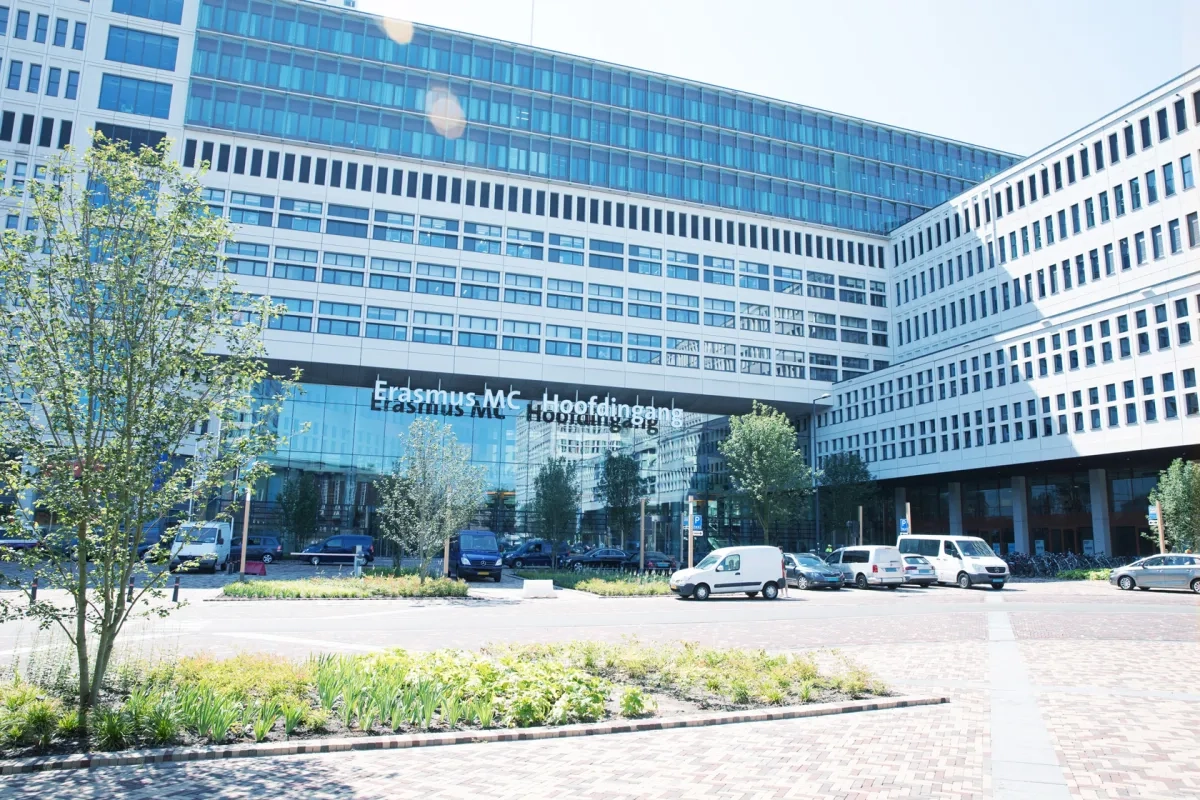
Pioneering, pushing boundaries and leading: in healthcare, education and research
Erasmus MC is an international leading academic hospital in Rotterdam. We are recognized as a world-class scientific research organization aiming to improve our understanding of diseases and disorders and helps to predict, treat and prevent them. We have access to the latest equipment and techniques. A working environment that gets the best out of people.
Find out more about Erasmus MC