
- All vacancies
-
PhD student in epidemiology to develop and apply causal triangulation
PhD student in epidemiology to develop and apply causal triangulation
Causal triangulation compares results from different study designs to help provided evidence for or against causation. We are looking for a PhD student to help us think through how this method can be better understood and applied.- Closing date 03-07-2026
- 3445
- 36 hours
- HBO
- Research & Education
- Closing date 03-07-2026
- 3445
Job description
Many key questions in epidemiology are fundamentally causal. Yet, we often have to rely on assumptions that cannot be directly verified to judge whether an observed association truly reflects causality. Causal triangulation offers a valuable tool to strengthen causal inference by comparing results from different study designs addressing the same question.
As part of this project, you will:
- Collaborate with our team to deepen the understanding of how causal triangulation works. This will rely heavily on causal inference but also formal reasoning and other methodological knowledge.
- In particular, this project will focus on how to quantitatively combine estimates from studies using different study designs.
- Help lay the groundwork for applying triangulation methods in practice (see DOI: 10.1007/s40471-023-00340-0).
- Apply triangulation to one or more concrete epidemiologic questions, such as the impact of cash transfers on child health — although we are open to other applications based on your interests.
You will also join a cohort of 8 PhD students across Erasmus MC, TU Delft, and Leiden University Medical Center, each focusing on different aspects of strengthening the safety and validity of causal inference in health research.
Work environment
As a PhD candidate, you’ll be based at Erasmus MC and become part of the Causal Inference Group; a lively community of students and faculty who meet regularly to exchange ideas, tackle methodological puzzles and explore new directions in causal research. It’s an inspiring, collaborative setting where there’s room to learn, share and grow together.
Your primary supervisor will be Dr. Jeremy Labrecque (scientific researcher). You’ll also benefit from the expertise and guidance of Dr. Jesse Krijthe at TU Delft and Dr. Stéphanie van der Pas at the Vrije Universiteit Amsterdam, who bring valuable perspectives and a strong network to your project. Together, this team offers a supportive environment to help you develop your skills and make an impact in the field.
Qualifications and skills
Some background in causal inference is a great advantage. There is room for learning on the job, but preference will be given to candidates who have taken courses or have demonstrated familiarity with at least the basics of causal inference:
- A Master’s degree in a quantitative research field (e.g., Biostatistics, Epidemiology, Economics, or Psychology).
- Strong ability to work collaboratively within a team, particularly within the Causal Inference Group and the Safe Causal Inference consortium.
- Proficiency in English (reading, writing, and speaking) sufficient to conduct and communicate scientific research.
Before you apply please check our conditions for employment.
Terms of employment
- You will receive a temporary position for 4 years.
- The gross monthly salary is € 3.108,- gradually increases to € 3.939,- in the 4th year (scale OIO) based on a full-time workweek of 36 hours.
- A salary increase of 3,5% from July 2026, according to the collective labor agreement (CLA)
- Partial working from home is possible, as is working 4 x 9 hours.
- Excellent fringe benefits, such as a 13th month that is already paid out in November and an individual travel expense package.
- An International Office which aids you in preparing for your arrival and stay.
- Pension insurance with ABP. We take care of approximately 2/3 of the monthly contribution.
- Special benefits, such as an incompany physiotherapist and bicycle repairer. And there is also a gym where you can work on your fitness after work.
More information
Make this job your next career move! Apply now using the application button. It all starts with taking action.
Do you have questions about the role? Feel free to reach out to Jeremy Labrecque, Associate Professor, via mail.
No agencies please.
Application proces
Application proces
Step 1 - Apply
Did we get you excited about this position? Submit your application through the application button. You will receive a confirmation of receipt from our recruiter right away.
Step 2 - Selection
Based on your application, we check to see if there is a fit between us. We will let you know as soon as possible whether you are invited for an interview.
Step 3 - Job interview
You have been invited for an interview, great! In this first meeting we get to know each other and see if You can form an idea of the position, the department and Erasmus MC. If the interview goes well usually a second interview follows.
Step 4 - Offer and terms of employment
It’s a match! Your future manager will discuss your salary and employment with you. You will also receive more information about our other terms of employment.
Step 5 - Getting started
Your first working day has come! We are more than happy to have you. Your new department will give you a warm welcome and provide you with all the information you need. Enjoy your job at Erasmus MC!

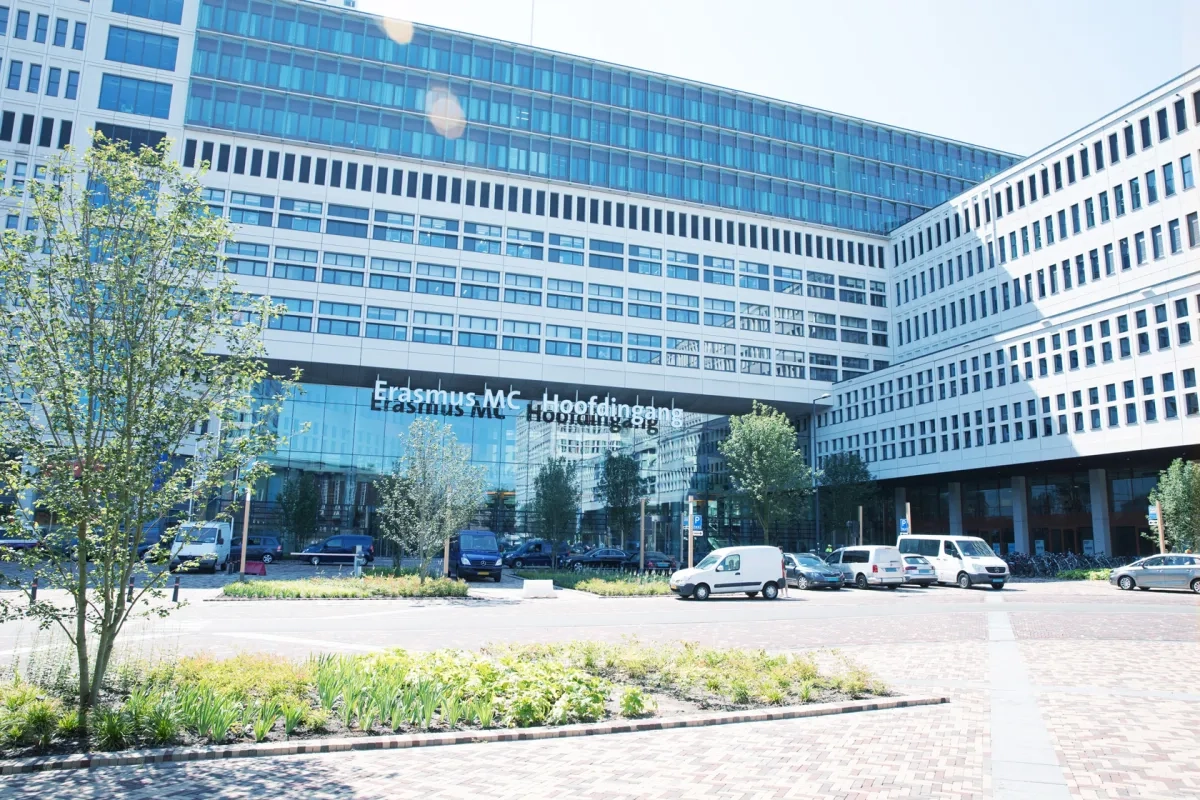
Pioneering, pushing boundaries and leading: in healthcare, education and research
Erasmus MC is an international leading academic hospital in Rotterdam. We are recognized as a world-class scientific research organization aiming to improve our understanding of diseases and disorders and helps to predict, treat and prevent them. We have access to the latest equipment and techniques. A working environment that gets the best out of people.
Find out more about Erasmus MC