
- All vacancies
-
PhD Candidate in AI-Based Retinal Imaging for Retinitis Pigmentosa
PhD Candidate in AI-Based Retinal Imaging for Retinitis Pigmentosa
Develop AI methods to detect and characterize cone photoreceptors in patients with retinitis pigmentosa and help create imaging biomarkers, in collaboration with the Rotterdam Eye Hospital.- Closing date 08-12-2026
- 4190
- 36 hours
- HBO
- Research & Education
- Closing date 08-12-2026
- 4190
Job description
Retinitis pigmentosa (RP) is an inherited retinal disease that progressively damages photoreceptors, the light-sensitive cells responsible for vision. Although new treatments, including gene therapies, are emerging, monitoring disease progression remains challenging because current clinical imaging techniques cannot always detect subtle changes in these cells.
Adaptive optics imaging enables visualisation of individual cone photoreceptors in the living human eye. However, in patients with RP, these cells often appear irregular, with changes in their shape, reflectivity, and spatial organisation. This makes automated detection and quantification difficult, while the relationship between these abnormalities and visual function is not yet fully understood.
Within the AICON project, Erasmus MC and the Rotterdam Eye Hospital aim to address these challenges by developing AI-based methods to automatically detect, quantify, and characterise cone photoreceptors in patients with RP. By combining adaptive optics imaging with Optical Coherence Tomography (OCT) and microperimetry, the project will investigate how microscopic changes relate to retinal structure, visual function, and disease progression. The ultimate goal is to develop reliable imaging biomarkers to support disease monitoring and future clinical trials.
As a PhD candidate, you will play a central role in this project, developing and validating AI and image analysis methods for detecting and characterising cone photoreceptors in diseased retinas. You will work with advanced retinal imaging datasets and collaborate closely with imaging researchers and ophthalmologists to investigate how cellular abnormalities relate to disease progression and patients' vision.
Responsibilities
- Contribute to data curation, quality assessment, and annotation in collaboration with a technical ophthalmic assistant and clinical specialists.
- Develop and validate AI-based methods for automated cone detection, phenotyping, and selection of retinal regions suitable for reliable analysis.
- Build reproducible pipelines to quantify cone density, spacing, regularity, and reflectivity.
- Analyse retrospective and longitudinal data to compare patients with healthy controls and relate retinal changes to visual function, and clinical findings.
Work environment
You will join the Eye Image Analysis Group Rotterdam (EyeR), a research line within the Biomedical Imaging Group Rotterdam (BIGR) in the Department of Radiology & Nuclear Medicine at Erasmus MC. BIGR brings together more than 50 researchers with engineering backgrounds, working on medical image analysis at different career stages, and offers a supportive environment for your development as a researcher.
EyeR connects BIGR with the Department of Ophthalmology at Erasmus MC and Rotterdam Eye Hospital. You will work alongside experts in AI, medical imaging, ophthalmology, linking the development of new analysis methods to clinical questions and patient data.
Collaborations with international academic groups and industry partners will provide opportunities to exchange expertise and evaluate your methods beyond the local research setting.
Qualifications and skills
We are looking for a curious and motivated researcher who enjoys developing computational methods and working with clinical colleagues. You bring:
- A Master’s degree in Biomedical Engineering, Computer Science, Artificial Intelligence, Applied Mathematics, Physics, or a related discipline.
- Good programming skills in Python and practical experience with machine learning or deep learning, gained through coursework, a thesis, or research projects.
- The ability to work independently, critically evaluate results, and collaborate with colleagues from different scientific and clinical backgrounds.
- Good written and spoken English for scientific communication and teamwork. Dutch is not required.
- Experience with medical imaging, frameworks such as PyTorch, statistical analysis, or research software development is an advantage. Previous knowledge of ophthalmology or adaptive optics is welcome but not required.
Before you apply please check our conditions for employment.
Terms of employment
- A 1-year contract with the option of yearly renewal, up to a maximum of 4 years.
- The gross monthly salary is € 3.217,- in the 1st year and it gradually increases to € 4.077,- in the 4th year (scale OIO) based on a full-time workweek of 36 hours.
- A salary increase of 3.5% from May 2027, according to the collective labor agreement (CLA).
- Partial working from home is possible, as is working 4 x 9 hours.
- Excellent fringe benefits, such as a 13th month that is already paid out in November and an individual travel expense package.
- An International Office which aids you in preparing for your arrival and stay.
- Pension insurance with ABP. We take care of approximately 2/3 of the monthly contribution.
- Special benefits, such as an incompany physiotherapist and bicycle repairer. And there is also a gym where you can work on your fitness after work.
More information
Make this job your next career move! Apply now using the application button. It all starts with taking action.
Do you have questions about the role? Feel free to reach out to Danilo Andrade De Jesus, Assistant Professor of AI and Medical Image Analysis in Ophthalmology, via mail.
No agencies please.
Application proces
Application proces
Step 1 - Apply
Did we get you excited about this position? Submit your application through the application button. You will receive a confirmation of receipt from our recruiter right away.
Step 2 - Selection
Based on your application, we check to see if there is a fit between us. We will let you know as soon as possible whether you are invited for an interview.
Step 3 - Job interview
You have been invited for an interview, great! In this first meeting we get to know each other and see if You can form an idea of the position, the department and Erasmus MC. If the interview goes well usually a second interview follows.
Step 4 - Offer and terms of employment
It’s a match! Your future manager will discuss your salary and employment with you. You will also receive more information about our other terms of employment.
Step 5 - Getting started
Your first working day has come! We are more than happy to have you. Your new department will give you a warm welcome and provide you with all the information you need. Enjoy your job at Erasmus MC!
Pioneering, pushing boundaries and leading: in healthcare, education and research
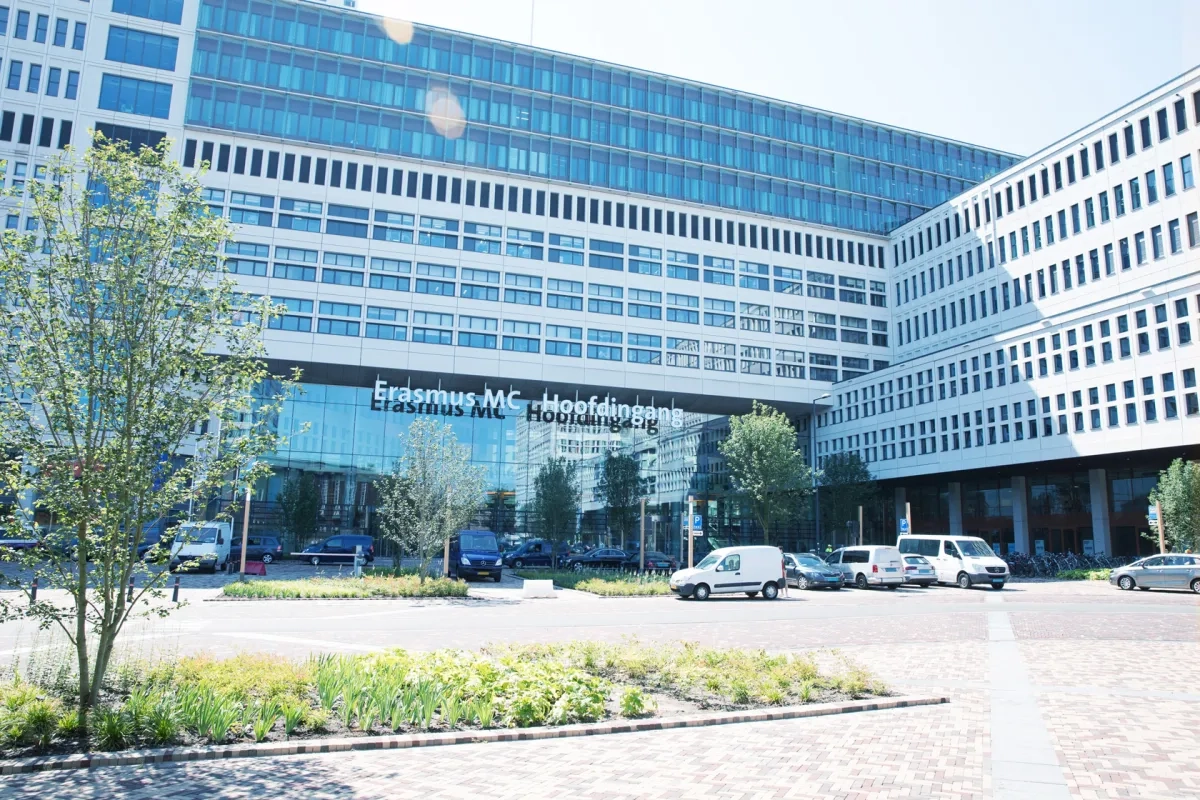
Erasmus MC is an international leading academic hospital in Rotterdam. We are recognized as a world-class scientific research organization aiming to improve our understanding of diseases and disorders and helps to predict, treat and prevent them. We have access to the latest equipment and techniques. A working environment that gets the best out of people.
Find out more about Erasmus MC